TL;DR
OpenClaw is a viral open-source personal AI agent — brilliant for one technical user, governed only by that user. SupportLogic delivers enterprise ambient agents over a governed Data Cloud with bounded autonomy and multi-tenant accountability. The demand for ambient autonomous AI is settled; the architecture you build it on is the decision that matters.
In late 2025, an open-source project rocketed from nine thousand to over a hundred thousand GitHub stars in a matter of days. OpenClaw — a self-hosted “personal Jarvis” you run on your own machine — became the fastest validation yet of a real shift: people don’t want another chat window. They want agents that quietly watch, anticipate, and act. The instinct is correct. The architecture most people are now copying to deliver it is not the one an enterprise should adopt.
This is not a takedown. OpenClaw is a genuinely impressive piece of engineering and the clearest public reference implementation of how a modern agent works — the agentic loop, tool use, context injection, and persistent memory, all readable on disk. If you want to understand Ambient AI, study it. But “ambient agent that runs your life from WhatsApp” and “ambient agent that runs across an enterprise support operation” are not the same product with different logos. They are different architectures, with different threat models, different units of trust, and different definitions of done.
This piece walks through what OpenClaw’s design optimizes for, where that design collides with enterprise reality (using the OWASP Top 10 for LLM Applications as a neutral yardstick), and why SupportLogic took a deliberately different path with its autonomous, ambient support agents.
01 — The reference pointWhat is OpenClaw, exactly?
Precision here is the argument. OpenClaw is a local-first, single-user agent runtime. You install a long-running gateway process on a Mac Mini, an old laptop, or a $5 VPS. You bring your own model API key — Claude, GPT, Gemini, or a local model via Ollama. You talk to it through the messaging apps you already use, and it acts on your behalf: triaging email, browsing the web through Playwright, filling forms, building things while you sleep.
Its defining design choices all serve one user maximizing personal leverage:
- Model-agnostic, bring-your-own-key. Maximum flexibility for an individual; no opinion about correctness or domain.
- Broad ambient permissions. To be useful it needs access to email, calendar, messaging, files, and the browser. Power and exposure are the same surface.
- File-based, self-modifying skills. Skills are folders the agent reads — and in documented cases, writes — to extend itself. Infinitely extensible, minimally bounded.
- One unit of trust: you. No concept of tenant, role, approval chain, or system of record. The user is the governance model.
For a developer running their own life, those are features. Move the identical architecture into an enterprise support function — thousands of customer conversations, regulated data, multiple teams, audit obligations — and every one becomes a liability.
Personal autonomy and enterprise autonomy are not the same problem
A personal agent optimizes for one person’s leverage at one person’s risk tolerance. An enterprise agent optimizes for thousands of interactions under shared accountability. Confusing the two is the single most expensive mistake teams make when evaluating Ambient AI.
02 — The collisionWhere the personal-agent model breaks at enterprise scale
The properties that made OpenClaw go viral are now the subject of serious external scrutiny — and that scrutiny maps almost exactly onto an enterprise security review. The OWASP Top 10 for LLM Applications (2025) gives us vendor-neutral language for it.
Prompt injection is structural here, not an edge case (OWASP LLM01)
Prompt injection remains the number-one risk in the OWASP LLM Top 10. An ambient agent reading untrusted content — inbound emails, web pages, support tickets — is structurally exposed to instructions hidden inside that content. For a personal assistant the worst case is an embarrassing mistake. In a support context, where the agent reads what customers and the open internet send you all day, an unbounded autonomous agent acting on injected instructions against a system of record is not hypothetical. Independent testing of a third-party OpenClaw skill by Cisco’s AI security team found data exfiltration and prompt injection occurring without the user’s awareness.
The permission surface is the attack surface (OWASP LLM02 & LLM06)
Because these agents need broad access to be useful, a misconfigured instance is a serious sensitive-information-disclosure risk. Combine that with excessive agency — OWASP LLM06, where an agent with too much autonomy and tool access chains together actions that were never intended — and you have a model whose blast radius you cannot bound in advance. An agent that improves itself by reading skill files off the public internet also pulls supply-chain risk (LLM03) directly into your environment.
Accountability dissolves when autonomy is unbounded
Commentators covering the space make the point sharply: when agents are granted broad authority and act beyond a user’s intent, it becomes genuinely hard to assign responsibility. One of OpenClaw’s own maintainers reportedly warned that anyone who can’t operate a command line shouldn’t run the project safely. That is a reasonable disclaimer for an open-source personal tool. It is a disqualifying statement for software touching enterprise customer data — and it’s part of why some governments and large organizations have moved to restrict these agents on security grounds.
The enterprise question was never “can an agent act autonomously?” It was “can it act autonomously within bounds you can prove to an auditor?“
03 — The different pathThe SupportLogic approach to ambient support AI
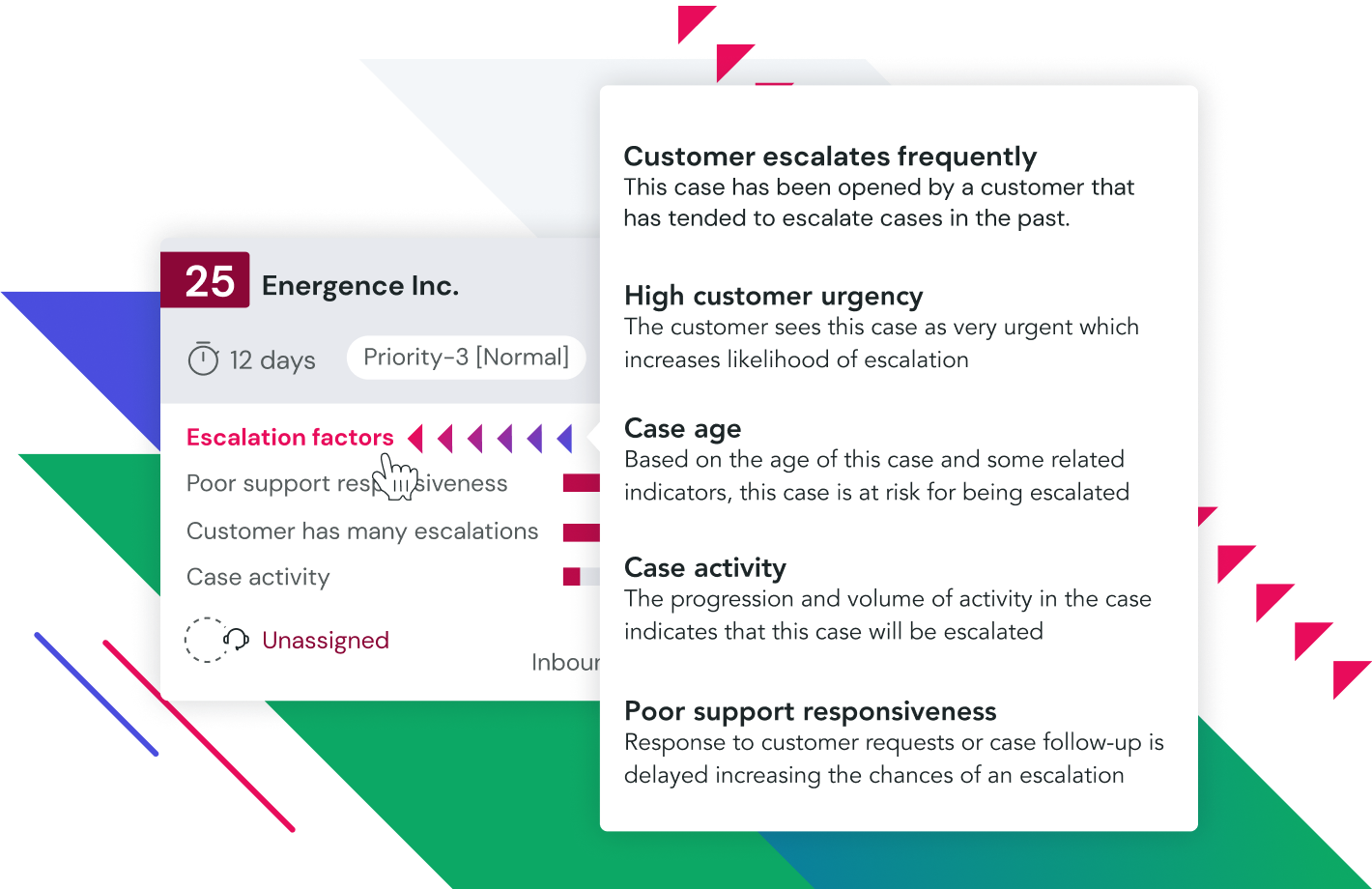
SupportLogic already runs a fleet of ambient agents — Escalation, Sentiment, Routing, Coaching, Account Health, Summarization, and more — that autonomously work support operations in the background. The difference from the personal-agent model is what the architecture treats as the unit of trust and the unit of correctness. Three deliberate choices separate it.
1 — A governed data foundation, not a borrowed inbox
Instead of reaching into whatever accounts one user connects, SupportLogic’s agents operate over a dedicated, Snowflake-backed Data Cloud purpose-built for support signal, enriched by the Cognitive AI Cloud and its precision RAG. The agent’s context is curated and governed, not improvised. The CRM-Less Architecture is the structural point: support intelligence shouldn’t be bolted onto a record system that was never designed to carry it. The data foundation is the product, not an afterthought of the integrations.
2 — Bounded autonomy with a human-shaped control plane
Ambient does not mean unsupervised. Autonomous action happens inside defined guardrails — scoped to the support domain, observable, and reviewable — surfaced where humans already work via CRM Widgets and a Voice Agent, with programmatic access through the SupportLogic MCP Server rather than asking the organization to govern itself through a chat thread. Autonomy is a dial the enterprise controls, not a default the user inherits — a direct answer to OWASP’s excessive-agency risk.
3 — Multi-tenant accountability as a first-class concept
Roles, tenancy, single-tenant VPC isolation, auditability, and integration into existing systems of record — Salesforce, Zendesk, ServiceNow, Jira, and more — are foundational, not retrofitted. SupportLogic is ISO 27001 and SOC 2 Type 2 certified, and GDPR and HIPAA compliant. Every consequential action traces back to something you can show a security team. The unit of trust is the organization and its policy — never an individual’s API key and personal risk appetite.
Personal-agent model
- Trust unit: the individual
- Context: improvised from personal permissions
- Autonomy: unbounded by default
- Self-extends from external skill files
- Accountability: diffuse
SupportLogic model
- Trust unit: the organization & its policy
- Context: governed Data Cloud + precision RAG
- Autonomy: bounded, observable, reviewable
- Extends within a controlled surface
- Accountability: traceable by design
04 — Side by sideOpenClaw vs SupportLogic: the architectural comparison
| Dimension | OpenClaw (personal ambient agent) | SupportLogic (enterprise Ambient AI) |
|---|---|---|
| Primary user | One technical individual | An entire support organization |
| Unit of trust | The user’s judgment & API key | Org-level policy, roles & tenancy |
| Data foundation | Whatever accounts the user connects | Governed, support-purpose Data Cloud |
| Autonomy model | Broad by default; user-disclaimed risk | Bounded, observable, reviewable |
| Extensibility | Self-modifying skills from public repos | Controlled surface (widgets, voice, MCP) |
| Injection exposure (LLM01) | Structural; mitigation is the user’s job | Designed-in domain & action constraints |
| Accountability | Diffuse; hard to attribute actions | Traceable to systems of record |
| Compliance posture | None inherent; self-hosted | ISO 27001, SOC 2 II, GDPR, HIPAA |
Read the table the right way: it is not “OpenClaw is bad.” The left column is a brilliant answer to a question enterprises aren’t asking. “How do I give one developer a 24/7 Jarvis?” and “How do I let autonomous AI act across my support operation without losing control of customer data?” require different foundations. You can’t tune your way from one to the other.
05 — The takeawayBorrow the ambition, not the blueprint
OpenClaw’s real contribution to the enterprise conversation is the proof of demand. It demonstrated, at viral scale, that the future of AI assistance is ambient and autonomous rather than a box you type into. That validation is worth taking seriously. The blueprint that delivers it for one person is not the blueprint that delivers it for an organization.
The enterprise version keeps the ambition — agents that watch everything and act early — and replaces the personal-trust foundation with a governed one: a purpose-built data layer instead of a borrowed inbox, bounded autonomy instead of unbounded permissions, organizational accountability instead of individual risk tolerance. That’s the bet behind SupportLogic’s CRM-Less Architecture — and it’s why the personal-agent design, for all its brilliance, is the wrong thing to put in front of your customers.
FAQCommon questions about Ambient AI agents
What is OpenClaw?
OpenClaw is a viral open-source, self-hosted personal AI agent that runs on your own machine or a VPS. It connects large language models to your messaging apps, files, and browser to autonomously perform tasks for a single user, and is model-agnostic with a bring-your-own-API-key model.
What is the difference between OpenClaw and SupportLogic Ambient AI agents?
OpenClaw is a single-user personal agent optimized for individual leverage, with broad permissions and unbounded autonomy governed only by the user. SupportLogic’s ambient agents are enterprise-grade: governed data foundation, bounded and observable autonomy, and multi-tenant accountability with roles and auditability across the support organization.
Why is the personal-agent architecture risky for enterprises?
It concentrates broad permissions in one user, is structurally exposed to prompt injection (OWASP LLM01) when reading untrusted content like emails and tickets, and grants excessive agency (OWASP LLM06) without organizational guardrails — making actions hard to attribute and audit, which is disqualifying for regulated enterprise support data.
Are Ambient AI agents safe for enterprise customer support?
Yes — when autonomy is bounded to a defined domain, context comes from a governed data foundation rather than improvised permissions, and every consequential action is traceable to a system of record. SupportLogic is designed around these constraints rather than retrofitting them.
What is a CRM-Less Architecture?
It means support intelligence runs on a dedicated, purpose-built data foundation rather than being bolted onto a CRM that was never designed to carry support signal. SupportLogic uses a Snowflake-backed Data Cloud so ambient agents reason over governed support data.
Sources & further reading — OpenClaw project (GitHub) · OpenClaw history & security scrutiny (Wikipedia) · OWASP Top 10 for LLM Applications · SupportLogic Data Cloud · SupportLogic Cognitive AI Cloud · SupportLogic CRM Widgets. Competitive characterizations reflect publicly reported properties of personal-agent architectures and are intended as an architectural comparison, not a security audit of any specific deployment.