The Ambient Decision Engine Behind Account & Case Cohort Summary
Read More


Thamizh Subramanian
Solutions ArchitectIn the traditional enterprise architecture, the Customer Relationship Management (CRM) system has long been the undisputed “System of Record.” It tracks every ticket, every timestamp, and every interaction.
Yet, for all its organizational utility, the CRMs are “data-rich but insight-poor.” It captures what happened, but it rarely explains why it happened or what will happen next. This structural limitation has relegated customer support to a department perpetually catching up to customer dissatisfaction.
To combat this, forward-thinking organizations are moving toward a Data-Driven System of Intelligence model. By integrating SupportLogic Data Cloud, companies are breaking down the silos that have trapped the “voice of the customer”.
This post provides an exhaustive technical and strategic exploration of how this integration works, the complex engineering hurdles it solves, and how to leverage SupportLogic Data Cloud with advanced AI capabilities to transform support data into a primary engine of enterprise growth.
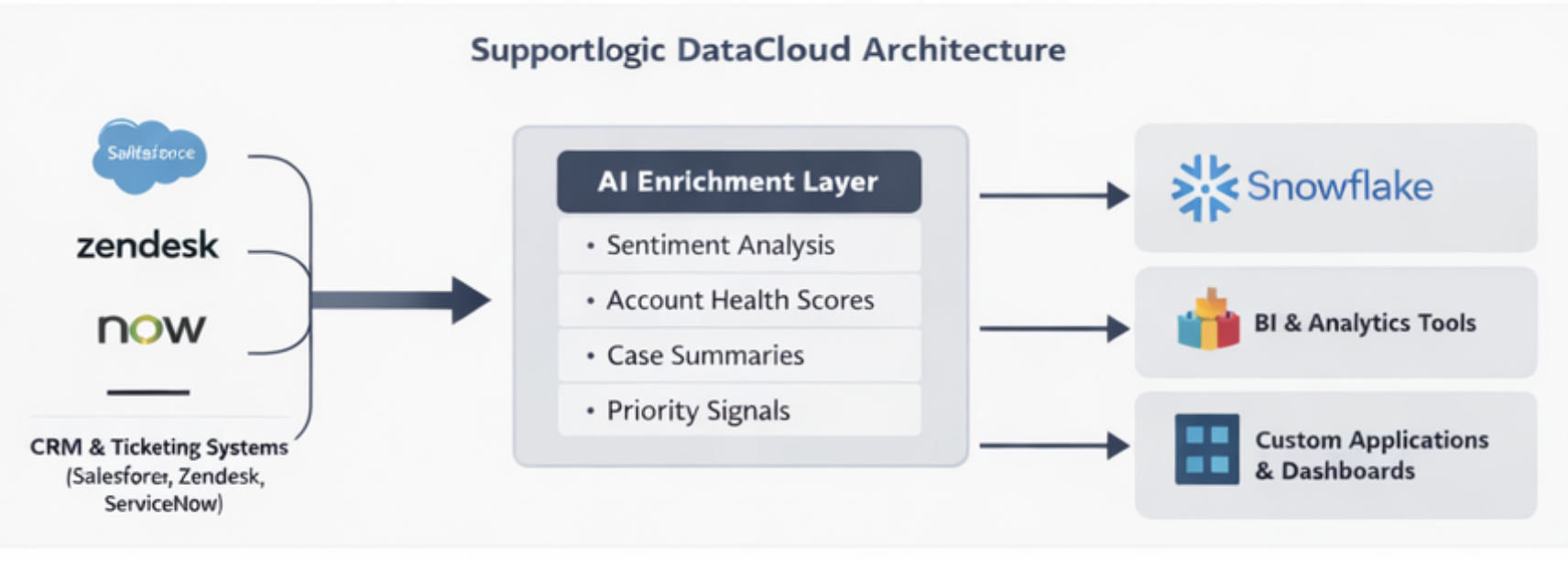
SupportLogic Data Cloud is not a mere reporting dashboard, it is an enterprise-grade data layer designed to gather AI-enriched telemetry. It sits strategically between the SupportLogic backend and your desired form of data consumption. Powered by Snowflake, the platform offers a variety of delivery mechanisms to ensure your data warehouse is never a bottleneck for real-time intelligence.
At the heart of Data Cloud is the enriched data from every interaction—case comments, emails, chat transcripts delivered by SupportLogic’s homegrown AI agents including:
Prioritization Agent: Converts multidimensional AI signals into patented scores that reflect the objective urgency and health of every case.
SupportLogic Data Cloud is designed to meet your data architecture where it lives. By utilizing Snowflake as the underlying engine, it offers three primary delivery tiers:
The most efficient method for Snowflake users, this “zero-ETL” approach provides a secure data share directly from SupportLogic’s instance to yours.
For organizations using other storage options or custom pipelines, SupportLogic Data Cloud supports automated scheduled exports to S3 or GCS.
For rapid prototyping or specific analytics needs, SupportLogic provides Snowflake Programmatic Access Tokens. This allows data analysts to connect tools like Tableau, PowerBI, or Sigma directly to the Data Cloud without a middle-man warehouse. Organizations with development capabilities have also built a direct API layer on top of SupportLogic Data Cloud using Programmatic Access tokens to build custom web applications and dashboards suited to their needs.
Building a dashboard or using a database that integrates data from multiple sources is a complex engineering challenge, often requiring extensive data transformation of multiple objects and ETL (Extract, Transform, Load) processes. SupportLogic Data Cloud helps you sidestep these technical challenges by providing a single source of truth, handling all required transformations and standardizing the data with a unified schema. Here are some of the major complex hurdles and how SupportLogic Data Cloud helps you overcome them:
The integration of SupportLogic Data Cloud creates a multiplier effect across the entire enterprise.
The Problem: Large support organizations with subprocessors struggle to gain a holistic view, limiting the ability to provide customized dashboards for internal leadership or external clients. This also limits the possibilities and expansion opportunities like providing a customized dashboard view for their customers, or an internal dashboard that can minimize the dependence of Support Leadership from their management layer.
The Technical Solutions:


The Outcome: Increased customer trust and the opportunity to provide premium “Executive Insight” service offerings packed with AI enriched features.
The Problem: Product prioritization often defaults to the “loudest” voice rather than the highest risk. Many decisions that could impact the prioritization of feature enhancements requested by customer stagnate at the Support layer and are not explicit for the entire organization as there is no holistic view that provides which customer is at the risk of churn or which customer has a growing frustration. A single action and decision based on this data could retain a potential churn risk customer or increase opportunities for expansion.
The Technical Solution: Leverage SupportLogic Data Cloud to segment cases by product, priority, sentiment, and account health.
The Outcome: Your organization shifts focus to “sentiment drivers” based on Revenue At Risk data, directly impacting Net Retention Rate (NRR).
The Problem: Traditional metrics like Mean-Time-To-Resolve (MTTR) don’t account for case complexity or customer temperament. An agent might have high MTTR because they are handling the most frustrated customers.
Technical Solution: Merge SupportLogic Sentiment Signals and Scores with Agent level Insights.
The Outcome: Improved proactive monitoring, reduced MTTR, and targeted skill development across the organization.
The Problem: In a recent blog post, Krishna Raja, CEO of SupportLogic and the author of “Support Experience” dissects how many enterprises are burdened by a “Support CRM Tax,” where multiple legacy CRM instances (Salesforce, Zendesk, ServiceNow, etc.,) act as siloed “digital filing cabinets”. These systems are often too cumbersome for AI workflows, leading to expensive DIY models for sentiment detection and intelligent routing. Furthermore, switching CRMs often results in a massive loss of historical context and intelligence.
The Technical Solution: Use SupportLogic Data Cloud as a Universal Data Layer. Data Cloud consolidates data from any system of record (SOR), migrates it into a unified Snowflake schema, and extracts signals without modifying the source. This allows organizations to move to a CRM-less architecture where Snowflake becomes the primary system of record and intelligence.
The Outcome: Organizations can consolidate disparate CRM instances into a single view, switch between ticketing providers without losing years of historical sentiment patterns, and significantly reduce operational costs by “outsmarting” the CRM rather than fighting it.
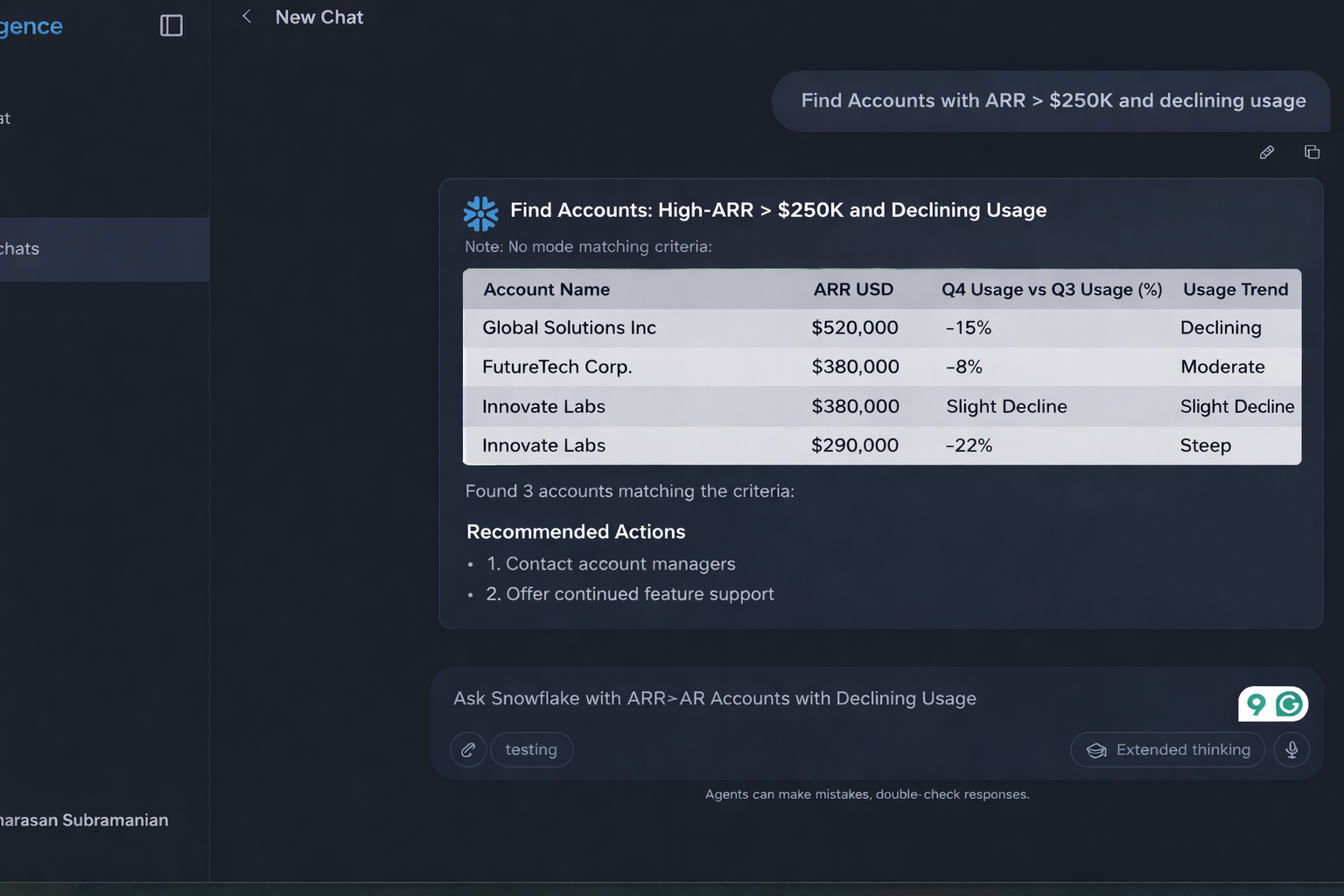
When SupportLogic Data Cloud is deployed within your Snowflake ecosystem, it unlocks a new tier of Intelligence capabilities. By layering Snowflake Agents over your enriched Data Cloud tables, you can transition from reading/observing data to Reasoning with data.
Move away from static reports & high-level dashbaords to an AI interface that translates natural language queries into business answers based on curated semantic views.
Use Cases:
Translate the generated passive signals into active context. Eliminate passive monitoring and reduce firefighting by creating triggered pipelines that actively notifies you when needed.
Example: Instead of a raw alert stating “Usage dropped 42%,” an intelligence pipeline generates: “Usage dropped 42% among enterprise tier users after pricing change. 3 open P1 tickets exist. Risk elevated.”
By combining SupportLogic enriched Case and account level summaries, scores and insights in Data Cloud with Snowflake’s vector search capabilities, you can build RAG systems. Leveraging the enriched summaries and scores as a Vector Database and setting the guardrail limitation within Snowflake, you can build your own ChatBots, Virtual Assistants, or Provide Technical Support with improved accuracy.
By moving to a data architecture where the CRM remains the system of record (SOR) but the SupportLogic Data Cloud becomes the system of intelligence, SupportLogic customers are fundamentally changing the rules of engagement.
Whether you are using it to power a custom ML model or to provide your Product team with a “Voice of the Customer” update, SupportLogic Data Cloud empowers you with the signals necessary to win in a customer-centric economy.
Support has evolved beyond analyzing ticket history to determine what went wrong. Today, it is a real-time stream of intelligence that informs sales strategy, product development, and executive decision-making. SupportLogic Data Cloud empowers the evolution of support from a reactive to a predictive and strategic data source.
Ready to set up your own system of intelligence and explore SupportLogic Data Cloud? Reach out to info@supportlogic.io.
Want the latest B2B Support, AI and ML blogs delivered straight to your inbox?