No More Surprise Renewals: How the Expand Module Turns Signals into Saves and Growth
Read More



Saurabh Agarwal
Sr. Machine Learning Engineer, SupportLogicLarge language models have reshaped how organizations think about summarization. When most people hear the word summary, they imagine a familiar process: a long paragraph or document is compressed into something shorter and more readable.
This type of summarization is purely textual, and while LLMs excel at it, it represents only a fraction of what enterprises actually need in operational environments.
When support leaders ask for an account summary or a cohort summary, they often assume this same mechanism (“give the model all the tickets and ask it to summarize”) is sufficient. But this assumption breaks the moment we step into enterprise-scale support operations. In these environments, insights cannot be extracted from text alone because the input is not text. Instead, the raw material exists as large, distributed, heterogeneous datasets: analytics metrics, ticket metadata, customer entitlements, engagement signals, resolution patterns, case taxonomies, SLA health, usage indicators, risk triggers, behavioural anomalies, and relationships across multiple data stores.
This is why true account-level and cohort-level insight generation demands an architectural approach that goes far beyond what any standalone LLM can perform.
This isn’t about shortening text. This is about transforming distributed, structured operational data into decision-ready intelligence.
Below, I’ll explain why this is the case and introduce the SupportLogic architecture that powers it.
Traditional summarization boils down to this:
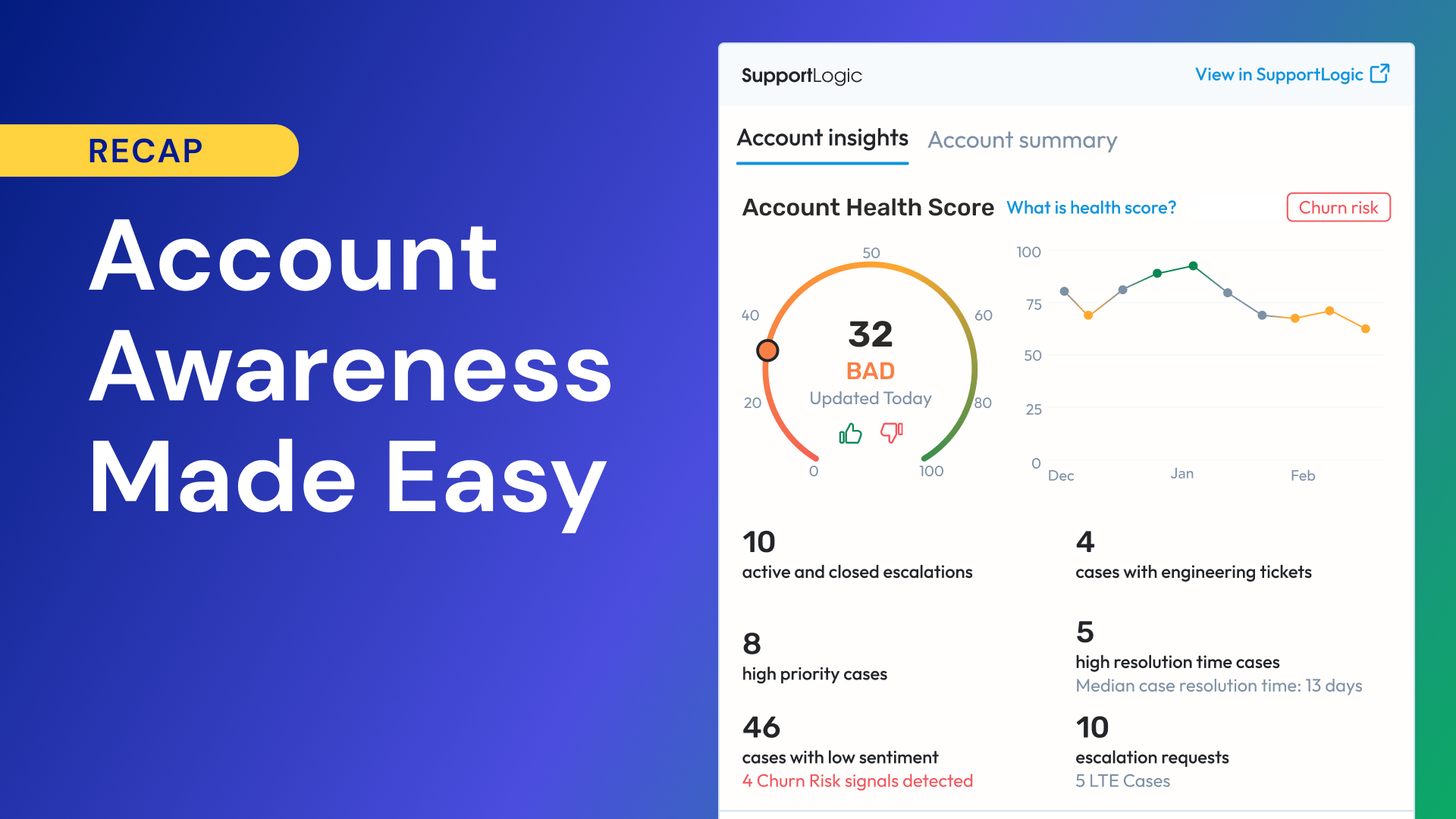
But support operations don’t store narratives, they store structured data and analytics. So there’s nothing to “summarize” in a traditional sense. Below is a video showing how this technolo
When dealing with enterprise support, we can’t summarize text; instead we must synthesize meaning from fragmented, structured, often pre-processed information, much of which never existed in natural language form. The system must detect relationships, compare cohorts, track anomalies, and infer patterns across time and across customers. These are tasks fundamentally different from textual summarization.
An account manager or support leader needs to know:
None of these emerge from “summarizing tickets.” These insights emerge from reasoning over large sets of data, not compressing text.
An LLM alone cannot make sense of it. It must be retrieved, fused, reasoned on, and only then narrated. Below is a video showing how this summarization affects the daily workflow of an account manager using SupportLogic.
To make such intelligence possible, the core of the platform is carefully engineered, anchored by a domain-specific schema that acts as the system’s cognitive backbone. Instead of passing raw text to an LLM, we orchestrate a multi-stage process:
In other words, the model does not “summarize”; it interprets a curated knowledge structure designed through engineering, analytics models, and domain-intelligence.
This is what enables the platform to highlight the right risks, detect patterns hidden from human view, and produce insights that match the mental model of a seasoned support manager – not the surface-level summary that a text-only LLM would generate.
Everything begins in the data lake or operational stores. This is not human text. This is the raw substrate of support intelligence. Examples of this material include:
This is not human text. This is the raw substrate of support intelligence.
This is the retrieval layer designed for databases, not documents. Structured RAG’s job is to extract only the relevant slices for building the insight. It uses:
Structured RAG’s job is to extract only the relevant slices for building the insight.
This layer combines everything retrieved into meaningful signal sets. Humans cannot interpret 500 raw signals; the fusion layer reduces them to interpretable constructs. It performs:
This is where intelligence emerges. This is far beyond summarization, this is interpretation and inference over operational data. Agents collaborate to:
This is far beyond summarization, this is interpretation and inference over operational data.
These insights are structured objects, not text. This component assembles:
Only at the final step does the LLM get involved. Its job is simple:
This ensures an output that is clean for humans while grounded in data.
A support ticket (even a long one) carries only a sliver of the full story. True support intelligence requires:
No LLM, when given only a single ticket or even a collection of tickets, could reconstruct this complexity. Only a structured, schema-driven architecture can. This is why account-level and cohort-level “summaries” are in reality system-generated operational intelligence.
The true value of this system becomes visible when we look at the outcomes it enables. By converting support data into coherent intelligence, the platform allows support teams to examine operations from multiple angles, each one offering a different “zoom level” of clarity.
Most importantly, the platform allows users to define their own custom cohorts: including product-specific, region-based, SLA-tiered, priority-driven, lifecycle-based, or any combination of attributes. This transforms the system into a true 360-degree observability framework, where managers can slice the support landscape however they want, grabbing insights that matter most for that specific context.
Instead of reactive firefighting based on noise from individual cases, leaders finally operate with strategic clarity: understanding where problems are forming, how widespread they are, which segments are affected, and what actions will drive the greatest impact.
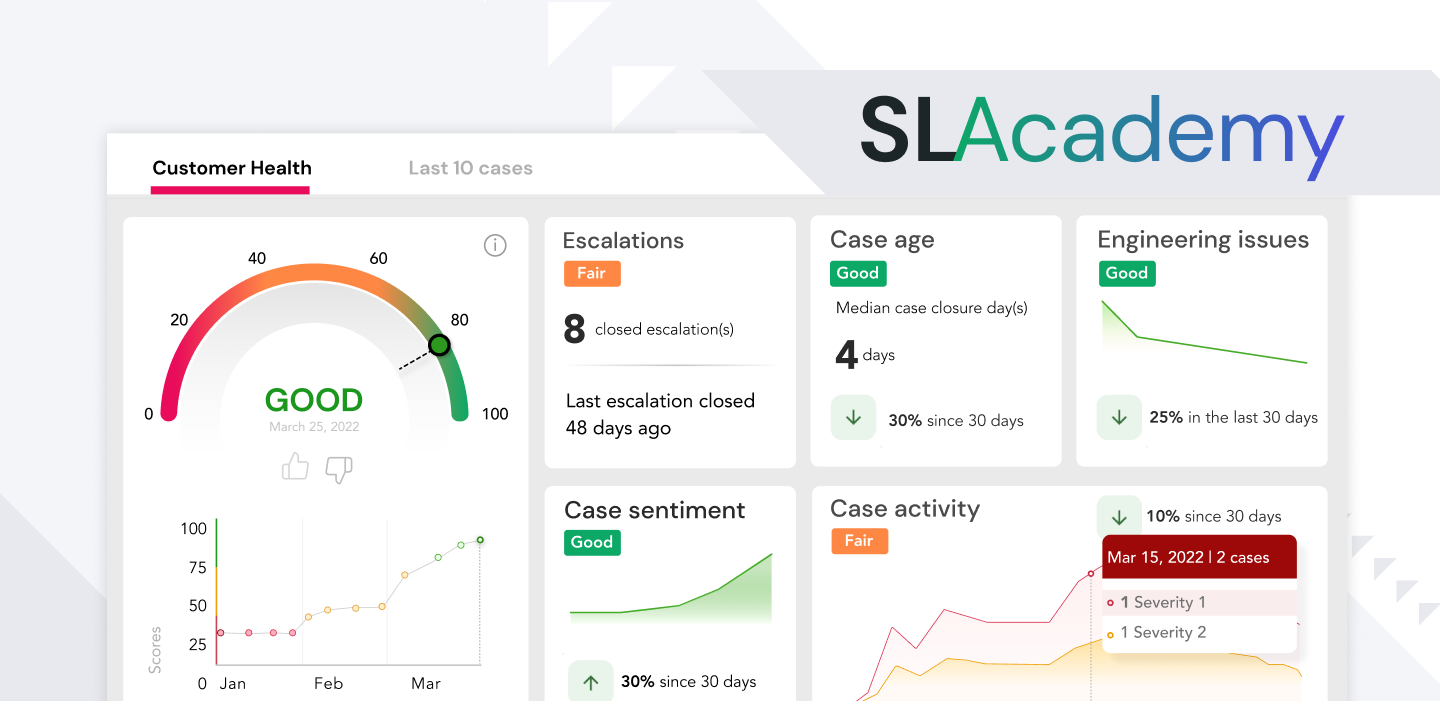
This surface simplicity is intentional. The complexity stays behind the scenes, inside the architecture. Below is an example of how this technology shows up in the workflow for a support manager:
Calling this capability a “summary” understates what is happening. The system interprets distributed enterprise data, fuses it using a domain-aligned schema, reasons across relationship graphs, and then uses an LLM only as a language interface – not as the engine of intelligence.
This layered architecture ensures that managers receive something text summarization could never deliver: A real-time, actionable, contextually accurate, data-driven understanding of their entire support landscape.
LLM is merely the narrator. The system behind it is the real intelligence engine.
Whether you’re new to SupportLogic or an existing customer, if you’re ready to move beyond text-only summarization and bring true operational intelligence into your support organization start here:
To explore deeper on what this technology enables, check out the resources below.
Want the latest B2B Support, AI and ML blogs delivered straight to your inbox?